Wednesday, March 24, 2010

Project 3: Medieval and Elizabethan Theatre, Directorial Concept

Directorial Concept: A Midsummer Night's Dream

Setting, Atmosphere/Lighting: Athens


Atmosphere/Lighting: Forest


Setting: Forest


Costume Inspirations


Theseus, Hippolyta, Egeus, Philostrate


Lysander


Hermia and Lysander


Demetrius


Helena


Helena


Titania


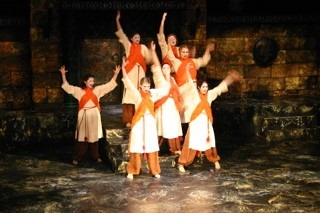
Fairies


Overall Concept

A Midsummer Summer Night’s Dream is a play of proportions. Real people are transformed while lost in a fantastical forest. Through all of the illusions, the main characters find the truth of themselves. I want to emphasize the hope within a rebellious decade of America: the 1980s. A Midsummer Night’s Dream is very adaptable to other era, which I find to be no different with the 1980s.

This decade provides especially distinct social atmosphere to play with. I would like to exaggerate the social elements of the 1980s. Theseus, Hippolyta, Egeus, and the Philostrate will be dressed as elite business people. Lysander and Hermia will be dressed “preppy,” a college version of the elders. Helena and Demetrius will be dressed as “punk,” to oppose their counterparts. This creates a visual division of the couple, foreshadowing their inevitable relationships. Oberon and Titania will be more like Greek gods than fairies. This represents the ancient power, whereas the Athenian royals are business people, a modern power. Their entourages will wear flowing fabric in bright, supernatural colors. I want the looks to be classical but the colors to be magical. The costumes of the acting troupe should look like generic blue collar workers. I want them in plain, neutral colored t-shirts and period blue jeans. Their play costumes should be made of average household items.

The music for Athens should sound like bad elevator music. The music for the forest should be influenced by the evolving music scene of the 1980s. The words of the music are not important, only the strict raw or electronic should of the sound should prevail. Whenever magic is applied by Puck, there should be a specific mystical sound. It should gear more towards a traditional whimsical sound. It should play into a sense of childlike pleasure and playfulness.

The setting for Athens should look like an office building in a skyscraper and a penthouse living room. I want there to be very angular furniture. Nothing in the world of Athens should look unique, only uniform, stale, and the same. The forest will be made with draping fabric. This promotes the look of softness and ever moving life. The fabrics can also be manipulated by the fairies to distort light. There can be some trees and actual aspects of nature, but the draping fabric should dominate as a replacement for nature. The fabric should add to the mysterious effect and hide much of the rest of the forest.

The lighting for the Athens should be plain and natural. I would also like a window gobo to represent a look of a penthouse living room. The lighting for the forest will set the mysterious, eerie, yet intriguing mood. I want it to look smoky and soft, completely different from the hard atmosphere of Athens. This can somewhat pull in aspects of the 1980s drug scene and experiences. The colors should be clearer and not diffused. Sometimes there should be blatant generic geometric shapes of colored lights within the forest. The lights for the forest, especially when the fairies are around, will be bold and blunt. I want there to be supersaturated, obvious colors.

Wednesday, February 24, 2010

Project #2: Commedia Dell'arte Mask

I have constructed a Commedia Dell’arte mask for the character, Brighella. He can be categorized as a zanni or member of the middle class. In the beginning of his history, Brighella was considered a zanni, but later found his own niche in the middle class, such as tavern owner. This makes him a very versatile character. I think it is very interesting that a zanni was be able to move up the social ladder; however, this situation has becomes a stock plot itself. The servant character finally gets power after all of his conniving, only to turn on the very social class he evolved from. Also, Brighella is considered Arlecchino’s smarter, vindictive older brother.

My mask is made with half a premade, molded mask. I Paper Mached over it with newspaper and a flour and water mixture. Once initially layered for reinforcement, I made various three dimensional shapes out of extra newspaper and masking tape to create the nose and nostrils of the mask. I later formed eyebrows. Then, I attached the shapes onto the mask with the same Paper Mache technique.

I have chosen to decorate my Brighella half-mask in the traditional green. Green symbolizes many things, like greed and supernatural lust. It can also be interpreted as the natural desires of man. Green most often represents jealousy and envy, sometimes considered an innate characteristic of man, exaggerated by Brighella. In some poetry, a “green” woman symbolized women who had been eroticized. This can connect to Brighella’s womanizing habits. After being primed with green spray paint, I added paint details to the mask. I used dark green to emphasize deep shadows as well as light green to add height to the three dimensional elements. I wanted to use broad, unidirectional strokes to emphasize the harsh aspects of Brighella’s character. I also splattered various shades of green to add texture. Lastly, I threaded some ribbon through premade slots on the side of the mask.

A Brighella mask has the option of a mustache. I chose not to add a mustache, because I wanted to emphasize the nose. Most Brighella masks exhibit a flatter and wider nose than that of other stock characters. The larger or broader the nose of the mask, the stupider the character. I like Brighella’s particular nose as a focal point of the face rather than a mustache, because it is fairly unique among the troupe. Again, it is broad and not so long, showing he is usually stupid; however, in some way, I find him introverted and sneaky with his plans, represented by the length of the nose. I believe the mustache is more significant for characters such as Il Capitano.

I feel as though my mask reflects an accurate interpretation of a Commedia Dell’arte Brighella mask. Some similar aspects are the color, general nose, and the three dimensional elements. Differences between my mask and a traditional or professional mask include the medium and more extreme exaggeration of facial features.

I enjoyed my mask making process, and I can only imagine how much effort went into masks during the peak of Commedia Dell’arte’s initial popularity.


Brighella Mask Reference Photos:

Friday, January 29, 2010

Project #1: Classical Tragedy, Photo Morgue


Productions of Plays by Aeschylus


The Persians (2006)
City Center, New York City, New York, U.S.A.
Lydia Koniordou, Director


The Persians (1951)
"A Rudimentary Theater," Ai-Stratis
Katrakis & Karousos, Director


Seven Against Thebes (2000)
The University of Melbourne, Melbourne, Australia
Paul Monaghan, Director


Prometheus Bound (2005)
The University of Melbourne, Melbourne, Australia
Paul Monaghan, Director


The Oresteia (2008)
Bradley Univerity, Peoria, Illinois, U.S.A.
George Brown & James Ferolo, Directors


Part I: Agamemnon (2008)
Classic Stage Company, New York City, New York, U.S.A.
Brian Kulick & Gisela Cardenas, Directors


Productions of Plays by Sophocles


Antigone (2006)
Valdosta State University, Valdosta, Georgia, U.S.A.
Jacque Wheeler, Director


Ajax (2007)
University of British Columbia, Vancouver, BC Canada
Cameron Crookston, Director


Ajax (2009)
Riverside Studios, London, England
Jack Shepherd, Director


Electra (2007)
Theatre 140, Romania
Mihai Manutiu, Director


Electra (2006)
Anderson Theatre, Gustavus Adolphus College, St. Peter, Minnesota, U.S.A.
Rob Gardner, Director


Electra (2006)
Casa del Pueblo, La Paz, Bolivia
Ariel Ragusa, Director


Philoctetes (2008)
Seattle Repertory Theatre, Seattle, Washington, U.S.A.
Tina Landau, Director


Productions of Plays by Euripides


The Bacchae (2004)
University of Florida, Gainesville, Florida, U.S.A.
Ralf Remshardt, Director


The Bacchae (2009)
Delacorte Theatre, New York City, New York, U.S.A.
JoAnne Akalaitis, Director


The Bacchae (2009)
Opéra Bastille, Paris, France
Krzysztof Warlikowski, Director


The Trojan Women: An Asian Story (2007)
Montclair State University, Montclair, New Jersey, U.S.A.
Aida Karic, Director


The Trojan Women (2007)
Michael Weller Theatre, New York City, New York, U.S.A.
Lauren Reinhard, Director


The Trojan Women (2005)
Duke University, Durham, North Carolina, U.S.A.
Ellen Hemphill, Director


The Trojan Women (2009)
University of Texas, Austin, Texas, U.S.A.
Halena Kays, Director


The Trojan Women (2009)
Michigan State University, East Lansing, Michigan, U.S.A.
David Furumoto, Director


Alcestis (2009)
Theatre of Delphi, Delphi, Greece
Thomas Moschopoulos, Director


Medea (2009)
University of California, Los Angeles, California, U.S.A.
Lenka Udovicki, Director


Trojan Women (1992)
Fringe Offices, Melbourne, Australia
Meredith Rogers, Director


Medea (1994)
Loeb Drama Center, Cambridge, Massachusettes, U.S.A.
François Rochaix, Director


Production Photo Response:

Much of the tangible elements of Greek productions are overemphasized to match the hyperbole portrayed. All of these pictures give a heightened sense of emotion and space. Everything is morphed to allow the audience to use their complete range of fantasy.

Lighting was a key player in the impact of the productions. In most of my photos, there are specific, bright light sources, thus creating deep shadows. I like deep shadows in the production photos, because they symbolize the perfect instance of secrecy. You will never know exactly what lies in the shadows, meaning you never know what a character is completely about. The bright light also plays with the element of dramatic irony. The audience knows everything about the characters, and these certain truths lay hidden from the other characters. All of these plays harbor dark and incomprehensible tales which are emphasized through the lighting.

In many of my photos, I found the fabric to be especially engaging. The texture of the fabric was very important in visually describing the emotional state of characters. If the fabric was ragged or torn, the distress of the character was more apparent. If the fabric was silky or free flowing, it demonstrated a more regal tone. Not only did the fabric separate characters, but it unified ensembles. A unification of texture and color often empowered the group, adding drama to the photo. Often times, fabric was run across the stage, creating a physical foreshadowing and connection of characters. This helps convey an eerie, psychic sense in the production photos. Draping fabric is a running element throughout most of these productions. The classic costume sense of draping influences the perception of time. The draping symbolizes a fragile fluidity and grace that always ends up being violently disrupted in the plays.

I found it very interesting that some of these Greek dramas seemed so easy to modernize, even expand to different cultures. I discovered that a production of The Persians was performed on an island of exile, Ai-Stratis. Performances became a tradition and a morale booster for those exiled to the island during the 1940s to 1950s. At Duke University, a production of Euripides's The Trojan Women was set in a circus. It was directed and designed this way to elevate the visual aspect of the pain and humiliation women and children feel as the ultimate victims of war. "The idea is to juxtapose the incredible darkness and weight of war against the grotesque color and playfulness of a carnival," (Allison Leyton-Brown). The Trojan Women: An Asian Story envelopes Euripides's The Trojan Women in a World War II setting. There are definite connections between the ancient text and the twentieth century occurrences. Japanese soldiers sexually exploited many women of different Asian countries, mostly Koreans. "Just as the Greek victors brutalized the innocent women of Troy, so, too, did the Japanese force hundreds of thousands into becoming 'comfort women,' (Anthony Venutolo). The photo itself of The Trojan Women: An Asian Story is so powerful that it evokes pangs of sorrow and defeat. Stories such as this pass down through time due to their universal triumphs, defeats, and overall messages. The most popular stories are those which the audience can relate and cross cultural barriers.

I really enjoy all of the photographs I have chosen for my project. I feel as though this research has given me a more defined, visual trend of recently produced Greek drama.

Links:
The Trojan Women
http://theaterstudies.duke.edu/tickets/the-trojan-women

The Trojan Women: An Asian Story
http://www.nj.com/entertainment/arts/index.ssf/2007/10/play_about_wars_savagery_links.html

The Persians Ai-Stratis
http://www.mouseiodimokratias.gr/english/exhibition6c.asp